
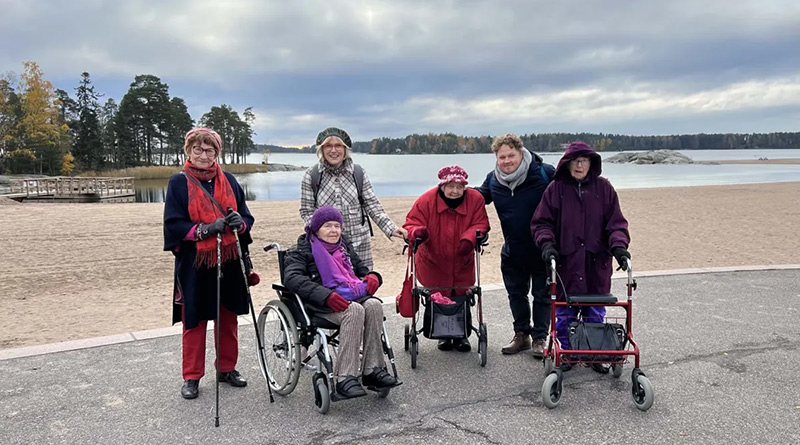
Nature-Based Group Activities Improve Wellbeing Among Older Adults Experiencing Loneliness
Nature-based group activities held just once a week over nine weeks can significantly reduce loneliness among care home residents — while also improving their sleep, memory and sense of connection to the natural world, new research has found.
The study, which centred on outdoor excursions and regular contact with nature, harnessed the combined power of peer support and structured activity to boost residents’ wellbeing and health. Its authors say the findings point to a pressing need for older adults in residential and nursing care to spend more time outside.
“Group activities once a week over just a nine-week period can already reduce loneliness in research subjects and improve their sleep and memory, as well as their sense of connection to nature,” said Professor Kaisu Pitkälä, Director of the Department of General Practice and Primary Health Care at the University of Helsinki. “Our study also highlighted the need for older adults in care homes to visit outdoor environments and nature more often.”
The researchers were surprised by the good results despite that the subjects had multiple diseases and that the conditions for nature-based activities were sometimes challenging, in terms of both weather and transport, as all subjects travelled to the excursions in wheelchairs and by accessible taxis. According to Pitkälä, activities over a longer duration would only have bolstered the outcome.
The researchers trained 52 group instructors in Helsinki-based care homes, which have subsequently disseminated the nature-based practices.
“Frail older adults have a great deal of resources, and by boosting those we support their wellbeing and health. More than half of care home residents experience loneliness, a risk factor comparable with tobacco and obesity for health and memory. Loneliness is not something you can see on the outside, you have to ask older adults about it,” Pitkälä notes.
The Circle of Friends scheme of the Finnish Association for the Welfare of Older People has attracted over 13,000 adults to group activities in more than 100 municipalities. After official activities have ended, 65% of the groups have continued independently.
“The study is an important step in drugless therapies, relatively few studies on which have been conducted in frail older adults with impaired memory who are in 24-hour care,” Pitkälä sums up.
The study involved 319 older adults living in care homes who experienced loneliness, with an average age of 83 years. A little over half of the participants had memory disorders. They were randomised into two groups, one of which took part in the nature-based group activities.