
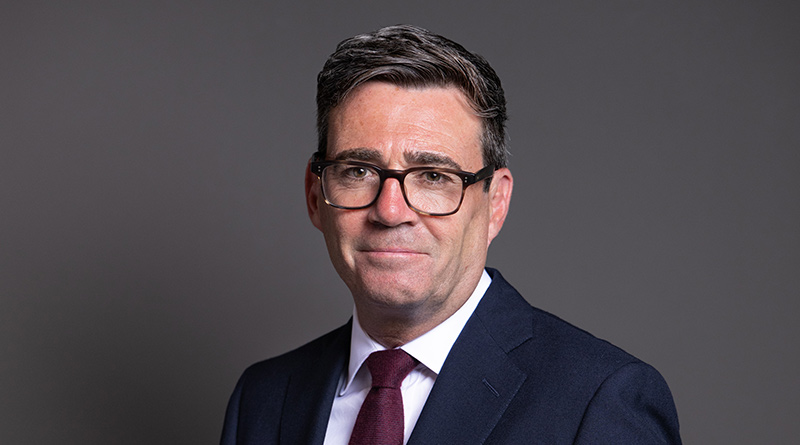
Burnham Outlines Vision for Universal Social Care Service in England
Prime Minister Andy Burnham has set out plans for a fundamental overhaul of adult social care in England, proposing a universal service which would be free at the point of use and funded collectively across the population.
Speaking as the Labour Party conference opened in Liverpool, Mr Burnham said he intended to make reforming social care a major long-term priority and indicated that Labour would take the proposals to the electorate at the next general election, currently expected to take place by 2029.
However, he ruled out introducing the proposed reforms before the election, saying voters should have the opportunity to consider the plans as part of Labour’s next manifesto.
The Prime Minister acknowledged that establishing a nationwide system on an NHS-style basis would represent a major undertaking, both financially and operationally.
He said he was prepared to take the political risks involved in attempting to reform a system that has proved difficult for successive governments to address.
Mr Burnham has not yet set out a detailed funding mechanism. He said work was continuing and that further information would be provided during his Labour conference speech on Tuesday.
Asked whether the proposed service would operate on broadly the same principle as the NHS, with people contributing collectively and receiving care without paying directly at the point of use, he said the model would be based on universal coverage, although the precise funding arrangements had yet to be determined.
He said Baroness Louise Casey, who is leading the government’s review of adult social care, would have an important role in advising on the details.
Funding remains a key question
The cost of creating a universal social care service is likely to be one of the most significant questions facing the government.
Mr Burnham rejected suggestions that the annual cost would necessarily reach £18bn, saying the eventual figure would be lower than that estimate.
He nevertheless acknowledged the constraints facing the public finances and said any reform would have to be developed carefully.
The Prime Minister said the government would need to consider how the costs could be distributed fairly while avoiding placing unsustainable additional pressure on public finances.
His comments come as the government faces continuing scrutiny over taxation, public spending and the wider state of the UK economy.
Mr Burnham also said that improving the way public services operate could generate savings over the longer term, including through a more preventative approach to issues such as homelessness and unemployment.
Personal experience of social care
Mr Burnham’s commitment to reform has also been influenced by his family’s experience of the care system.
His father, Roy, who had Alzheimer’s disease, died earlier this month after receiving care in a residential setting.
Reflecting on the experience, the Prime Minister paid tribute to the care workers who had supported his father and highlighted what he described as the skill, humanity and dedication of the workforce.
He also questioned whether care workers receive sufficient recognition and reward for the responsibilities involved in looking after vulnerable people.
The social care workforce is already facing significant recruitment, retention and pay pressures, while providers continue to operate against a backdrop of rising costs and financial uncertainty.
Long-standing ambition
Reforming social care is not a new policy objective for Mr Burnham.
While serving as Health Secretary in 2009, he proposed establishing a National Care Service broadly modelled on the NHS.
That earlier proposal included a mechanism for raising money through estates after death. The proposal subsequently became politically controversial, with opponents describing it as a “death tax”, and it was ultimately abandoned following Labour’s defeat at the 2010 general election.
Mr Burnham has indicated that previous proposals should not automatically be regarded as a blueprint for his current plans, although he has said that a range of funding options remains open for consideration.
Call for cross-party agreement
The Prime Minister also called for a different political approach to social care reform, arguing that major changes would require a degree of cross-party cooperation.
He said successive attempts to reform the system had been vulnerable to political opposition and public concern over how changes might affect individuals and families.
Mr Burnham said he had already begun discussions with politicians from other parties and suggested that a durable settlement would require politicians to address difficult questions openly rather than allow the debate to become dominated by competing political attacks.
The government’s approach is expected to become clearer as the Casey review progresses and ministers set out their longer-term proposals.
For care providers and the wider social care sector, the key issues will include how a universal system would be financed, the role of local authorities and independent providers, workforce pay and recruitment, eligibility, commissioning arrangements and the transition from the existing means-tested system.
Mr Burnham has made clear that he intends social care reform to form part of Labour’s offer at the next general election. The precise shape of the proposed system, however, remains subject to further work and consultation.