
CAA Shows Government How the Care Sector Can Help Solve the NEET Crisis
The Care Association Alliance (CAA) today sets out a roadmap to tackle the NEET crisis through careers in care.
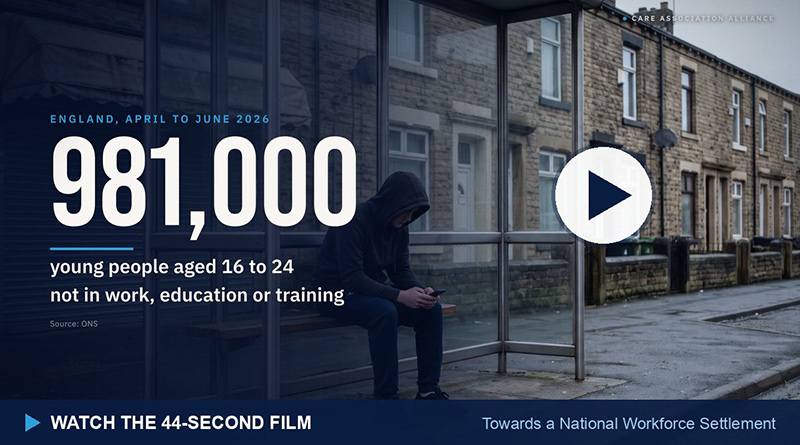
The number of 16 to 24-year-olds not in education, employment or training passed one million in January to March 2026 for the first time since 2013. It stood at 981,000 in April to June, still 30,000 higher than a year earlier. Alan Milburn’s interim review warned in May that it could reach 1.25 million within five years, a rise from one in eight young people to one in six.
Adult social care, meanwhile, has around 96,000 unfilled posts and a vacancy rate still well above the wider economy’s. Across England, close to three young people claim unemployment-related benefits for every vacancy: 288,470 claimants against around 96,000 unfilled posts.
The CAA’s second policy paper, Towards a National Workforce Settlement, argues that the two problems should be solved together, and sets out how.
The roadmap
The Youth Guarantee names health and social care as one of three sectors for its 350,000 training and work experience opportunities. But a placement is not a career, and no route leads from one to the other.
The CAA has built that route. Its Pathway into Care programme adds what a young person’s first weeks in care require: structured supervision, honest preparation for the emotional side of the work, and a defined step from placement into a job.
The CAA asks government to adopt it within the Youth Guarantee. It needs a decision, not a new budget line.
Recruitment is not the sector’s real problem. Retention is. More than half of care workers under 20 leave within their first year, and Skills for Care’s latest figures show under-25s have the highest turnover of any age group, at 35.5 per cent.
Pay is part of the reason. A care worker with five or more years’ experience now earns 12p an hour more than one with less than a year, down from 33p in 2016. The sector rewards presence rather than progression.
The paper’s four immediate asks are aimed at that: Level 4 qualification funding, a qualification fund restored to the £53.9m at which it was designed, a national competency record that follows the worker, and independent prescribing for 1,000 social care nurses. Together they cost £61m to £76m a year.
The funding does not fit either. The Youth Guarantee’s routes, including the £3,000 Youth Jobs Grant, were not designed around how social care employs people. The CAA asks the Treasury and the Department for Work and Pensions to fix the mechanism.
Young people are not the only pool. Some 27 per cent of today’s workforce is over 55, and career switchers need the same route.
On the paper’s midpoint estimates, the package pays for itself. The sector loses around 320,000 people a year, at a replacement cost of £1.2bn to £1.9bn. Cutting turnover by one percentage point returns between £52m and £87m a year.
The service of the future
The Prime Minister has set out plans for a National Care Service, free at the point of use and funded collectively. It would be introduced in the next parliament, after the next general election, which must be held by mid-2029.
That date matters. The 16 to 24-year-olds who are not in work or training today will be in their twenties when it arrives. They are the workforce it will have to hire.
The sector cannot staff it from the people it has. Skills for Care projects a need for 410,000 more posts by 2040. The number of posts filled by British workers has fallen by 130,000 since 2020/21, and under-25s make up only 7 per cent of the workforce.
A National Care Service built on the current workforce would be built on one that is ageing out and shrinking. For the CAA, young people are the service’s workforce, and the roadmap is how it gets one.
Melanie Weatherley MBE, Co-Chair of the Care Association Alliance, said:
“Every good care relationship runs in both directions. An older person gives a young worker purpose, and a young worker gives an older person care. A National Care Service that we can all be proud of needs to make it possible for this exchange to take place, and that means offering young people a career, not just a placement.
“We have close to a million young people the labour market has not found a place for, and a sector that cannot fill its posts. Those are two halves of the same problem, and we are one of the most obvious answers to it. The route in already exists. What we need from government is a decision to adopt it, and a funding mechanism that fits the way care actually employs people.
“Getting young people in is only the start. If they leave within a year because there is no progression and no recognition, we will have lost them. The National Care Service is years away, and the people who will staff it are 16 to 24 today. This roadmap is how we start.”
The Rt Hon Damian Green, Senior Policy Adviser to the CAA, said:
“This practical set of proposals hits two targets at once. It reduces pressure on the care sector, which needs new workers and to keep more of its existing ones, and it helps young people into a rewarding career. I very much hope Ministers will look at it seriously and adopt it as part of the long-awaited reform of the care sector.”