
Setting Care Homes on the Road to Net Zero
 As sustainability rises up the agenda for care organisations, heat is a natural target for efficiency improvement. Andy Green, Head of Technical Solutions at Baxi, discusses the importance of planning a net zero pathway and some of the achievable options for care home operators.
The UK’s circa 17,000 care homes may vary in size and age, but reliable heating and hot water is essential in each to prioritise the wellbeing and comfort of their residents. As this service is typically the largest user of energy in care home facilities, it’s also a good starting point for reducing operating costs and associated carbon emissions.
Let’s consider some of the achievable measures to improve the efficiency of the heating system and reduce its carbon impact.
Plot your pathway
In our recent survey of over 400 care homes managers, budget pressures, eligibility for funding and technical understanding of achievable options were the top challenges listed when considering decarbonising heat in their buildings. Subsequent focus group sessions also revealed that unplanned replacements are common, frequently resulting in a like-for-like distress purchase rather than enabling the care home operator to plan and implement a phased approach to net zero.
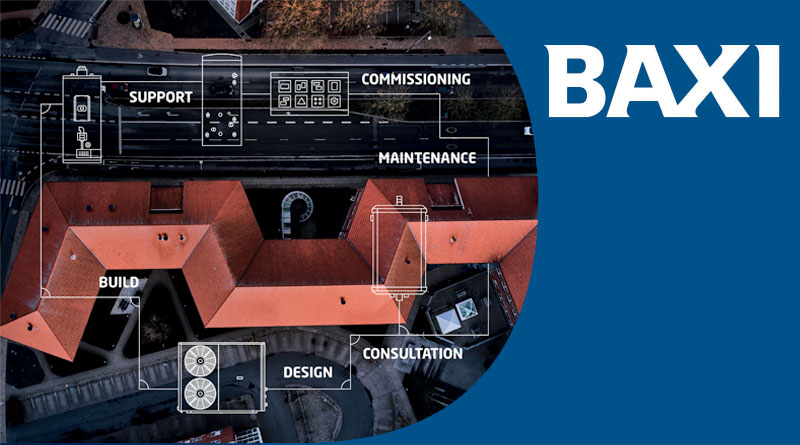
But with care homes coming under increased pressure to adopt sustainable practices in line with the nation’s wider 2050 net zero target, putting a roadmap in place is absolutely key. Fortunately, care home managers have access to heat experts like Baxi for support. We work closely with care homes first to understand the viable options for improved system efficiency and then to help them plot their unique net zero pathway.
Reduce heat losses
The first step should always be to understand how and where energy is being used in the building. Identifying and limiting any heat loss to the environment will not only immediately improve operating costs but can significantly reduce the size or capacity of plant required when refurbishing the system – which in turn will lower the required capital expenditure.
Practical examples might include building fabric upgrades such as roof and wall insulation, draught proofing and/or improving the thermal performance of windows and doors.
Adding lagging to poorly insulated pipework will also prevent heat losses within the system for improved performance.
Where necessary, adjust the heating controls and thermostat settings to optimise the temperature regimes and balance energy efficiency with thermal comfort.
‘Heat pump ready’
Light refurbishment still accounts for much of the work in the care home sectors according to our focus group research, despite the willingness shown for embarking on heat decarbonisation projects.
If upgrading to more efficient gas condensing boilers or direct-fired water heaters, use this opportunity to prepare the heating system for the integration of low temperature heat pumps at a future stage.
Addressing the system’s distribution pipework and heat emitters will allow the system to operate more efficiently at a maximum flow temperature of 55°C (or lower), in line with Building Regulations. This will also allow the condensing boilers and water heaters to operate in condensing mode, where they achieve their maximum efficiencies.
Fully electric or hybrid?
Replacing existing gas boilers or water heaters with heat pumps is the ultimate goal. New build care homes will be designed to require less heat for operational use and optimised for a decarbonised electricity grid. In buildings like these, a fully electric approach to heating and domestic hot water (DHW) based around renewable solutions such as our Auriga mid temperature and Auriga HP + high temperature heat pumps will be the favoured approach, particularly when combined with solar thermal and/or solar PV solutions.
In care homes with complex refurbishment challenges, a phased pathway may be necessary. In such buildings, a hybrid heat pump system combining heat pumps with existing boilers and/or water heaters is often a fast, affordable solution to partial decarbonisation. This will enable a large portion of the heat in the building to be decarbonised while meeting safe operation requirements.
Manufacturer support
Each care home project and building will have its own requirements, so it is advisable to consult with the experts.
Experienced heating and hot water solutions providers like Baxi can help break down the complexities for care homes by clearly explaining the options and outlining the associated carbon, energy and cost impacts of each. Working together, we can help ensure that the right decision is made to meet the specific needs of your building to set it on its path to net zero.
For more information, visit: Baxi Commercial Heating and Hot Water Solutions – www.baxi.co.uk/commercial